Attributes Of Quadrilaterals
Quadrilaterals are four‑sided polygons that appear in everyday geometry. Understanding their attributes—such as side lengths, angles, symmetry, and special properties—helps students classify shapes, solve problems, and recognize patterns in both theoretical and applied contexts. This guide covers the main types of quadrilaterals, the key attributes that distinguish them, and resources for deeper learning.
1. Core Attributes of Any Quadrilateral
- Four Sides and Four Angles – By definition, a quadrilateral has exactly four sides and four interior angles. The sum of all interior angles is always 360°.
- Opposite Sides – In many quadrilaterals, opposite sides are parallel, equal, or both. When both conditions hold, the figure is a parallelogram.
- Diagonals – A quadrilateral has two diagonals that may intersect at right angles, bisect each other, or have equal lengths, depending on the type.
- Symmetry – Some quadrilaterals possess reflection or rotational symmetry, influencing properties like equal sides or angles.
2. The Six Main Types of Quadrilaterals
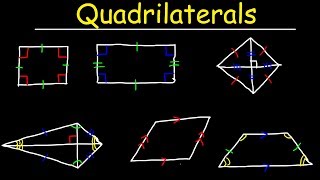
- Parallelogram – Opposite sides are parallel and equal. Opposite angles are equal, and diagonals bisect each other but are not necessarily equal.
- Rectangle – A parallelogram with all angles 90°. Opposite sides remain equal and parallel; diagonals are equal.
- Rhombus – All sides equal, opposite angles equal, diagonals perpendicular and bisect each other at right angles.
- Square – A special case of both rectangle and rhombus: all sides equal, all angles 90°, diagonals equal and perpendicular.
- Trapezoid (US) / Trapezium (UK) – Exactly one pair of opposite sides is parallel. The other pair may be of unequal length.
- Isosceles Trapezoid – A trapezoid whose non‑parallel sides are equal in length, giving it symmetry about the perpendicular bisector of the bases.
3. Distinguishing Attributes: How to Classify
Classifying a quadrilateral often begins with checking for parallelism and side equality. Below is a quick decision tree:
- Are any sides parallel?
- If yes, proceed to check how many pairs are parallel.
- If no, the shape is a general quadrilateral.
- How many pairs of parallel sides?
- Two pairs → Parallelogram family (check side lengths to decide rectangle, rhombus, or square).
- One pair → Trapezoid family (check side equality for isosceles).
- Are all sides