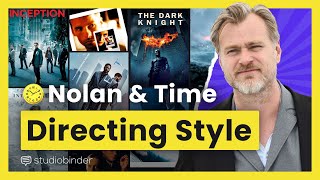
Christopher Nolan Movies About Time: A Deep Dive into Chronological Storytelling
Christopher Nolan has built a reputation for turning the abstract concept of time into a cinematic playground. From the fractured memories of Memento to the temporal warfare of Tenet, his films invite audiences to question the linearity of narrative and the nature of causality. This article explores the Nolan movies that place time at the core of their storytelling, highlighting how each film manipulates chronology to deepen theme and tension.
1. Memento (2000) – Memory as Time
Directed by Nolan, Memento is a 2000 American neo‑noir psychological thriller that tells its story in reverse. The protagonist, Leonard, suffers from short‑term memory loss, forcing the audience to experience events in a non‑linear fashion. By alternating between black‑and‑white scenes that move forward and color scenes that move backward, Nolan creates a puzzle‑like structure that mirrors Leonard’s fragmented perception of time.
2. Inception (2010) – Dream Layers and Time Dilation
In Inception, time becomes a malleable resource within shared dreams. Nolan layers three dream levels, each operating at a slower rate than the one above it. The famous “kick” sequence illustrates how a single minute in reality can stretch into hours inside a dream. This manipulation of temporal flow underscores the film’s central theme: the cost of escaping reality through imagination.
3. Interstellar (2014) – Relativity on a Cosmic Scale
While Interstellar is often celebrated for its astrophysics, its emotional core is rooted in time dilation. The crew’s brief visit to the water planet results in decades passing on Earth, a consequence of Einstein’s theory of relativity. Nolan uses this disparity to explore love, sacrifice, and the endurance of human connection across centuries, making time both a scientific and a deeply personal element.
4. Dunkirk (2017) – Simultaneous Timelines
Although a war film, Dunkirk demonstrates Nolan’s fascination with parallel timelines. The narrative unfolds on three interwoven strands—land, sea, and air—each with its own duration (one week, one day, and one hour respectively). By converging these timelines at the climax, Nolan compresses the chaotic evacuation into a single, relentless experience, emphasizing how perception of time can shift under extreme stress.
5. Tenet (2020) – Inverted Time
As Tenet continues its pandemic‑delayed journey to theaters, we can only guess the extent to which audiences will appreciate its daring use of temporal inversion. The film introduces “time