What Are Claim Starters and Why They Matter
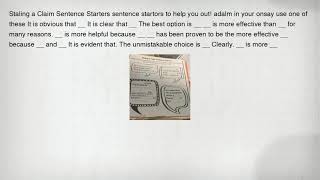
When you write an argumentative essay, a research paper, or a persuasive speech, the claim is the central statement you want your audience to accept. Claim starters are the phrases and structures that introduce that statement clearly and confidently. Using effective claim starters helps you:
- Grab the reader’s attention immediately.
- Establish a clear focus for the entire piece.
- Provide a logical bridge to the evidence that follows.
Without a strong opening claim, even the best evidence can feel disconnected, and readers may lose interest before you get to the heart of your argument.
Common Types of Claim Starters
Different writing contexts call for different claim‑starter styles. Below are the most frequently used categories, each with examples that you can adapt to your own topics.
1. Direct Statements
These are straightforward and assertive, ideal for academic essays where clarity is paramount.
- “Climate change is the most pressing environmental issue of the 21st century.”
- “Social media platforms are responsible for the spread of misinformation.”
- “Renewable energy investments yield higher long‑term economic returns than fossil fuels.”
2. Question‑Based Starters
Opening with a rhetorical question engages readers and prompts them to think critically about the topic.
- “What would happen if schools eliminated standardized testing altogether?”
- “Can artificial intelligence ever truly understand human emotions?”
- “Why do so many consumers ignore product safety warnings?”
3. Conditional Statements
These link a condition to the claim, showing cause and effect or a scenario that must be considered.
- “If governments increase funding for public transportation, traffic congestion will decrease dramatically.”
- “When companies adopt flexible work policies, employee productivity tends to rise.”
- “Should we continue to rely on non‑renewable resources, climate instability will worsen.”
4. Comparative Starters
Comparisons help position your claim relative to another idea, making the argument more nuanced.
- “Unlike traditional classrooms, online learning offers greater accessibility for remote students.”
- “Compared with fossil fuels, solar power provides a cleaner energy source with fewer health risks.”
- “While many diets focus on calorie counting, a whole‑food approach improves overall nutrition.”
How to Choose the Right Claim Starter for Your Piece
Selecting the best claim starter depends on three key factors: audience, purpose, and tone.
Audience
Consider who will read your work. Academic audiences expect direct statements, whereas blog readers may respond better to question‑based or conversational starters.
Purpose
If your goal is to persuade, a bold direct claim often works best. If you aim to provoke thought, a question or conditional starter can be more effective.
Tone
Professional or formal tones benefit from concise, declarative language. A more informal tone allows for playful or rhetorical starters without sacrificing credibility.
Step‑by‑Step Guide to Crafting Powerful Claim Starters
Follow this simple process to ensure your claim is both compelling and well‑structured.
- Identify the core argument. Write a one‑sentence summary of the point you want to prove.
- Choose a starter type. Match the summary to one of the categories above based on audience and purpose.
- Incorporate keywords. For SEO‑friendly writing, embed relevant keywords—such as “Claim Starters”—naturally within the claim.
- Test clarity. Read the claim aloud; it should be clear, concise, and free of jargon.
- Link to evidence. Ensure the claim can be directly supported by the data or examples you will present next.
Common Mistakes to Avoid
Even experienced writers sometimes stumble when crafting claim starters. Here are pitfalls to watch for:
- Vagueness: “Technology is important.” – This is too broad to be persuasive.
- Over‑complexity: Using overly technical language can alienate readers.
- Unsupported absolutes: Phrases like “always” or “never” require strong evidence; otherwise, they weaken credibility.
- Keyword stuffing: Inserting “Claim Starters” unnaturally harms readability and SEO performance.
Examples of Effective Claim Starters in Action
Below are short excerpts that demonstrate how a well‑chosen claim starter sets up a strong argument.
Example 1 – Academic Essay
“Renewable energy investments yield higher long‑term economic returns than fossil fuels.” This direct claim immediately tells the reader the stance and prepares the essay to present economic data and case studies.
Example 2 – Blog Post
“What would happen if schools eliminated standardized testing altogether?” The rhetorical question invites readers to imagine a scenario, making the subsequent discussion about alternative assessment methods more engaging.
Example 3 – Business Report
“If companies adopt flexible work policies, employee productivity tends to rise.” The conditional starter links a specific action to a measurable outcome, setting the stage for statistical evidence.
Conclusion: Mastering Claim Starters Elevates Your Writing
Effective claim starters are more than just opening phrases; they are the foundation of persuasive, organized, and SEO‑friendly content. By understanding the types, tailoring them to your audience, and avoiding common errors, you can craft claims that capture attention and guide readers smoothly toward your evidence.
Practice the step‑by‑step guide, experiment with different starter styles, and review your work for clarity. Over time, you’ll develop an intuitive sense for the perfect claim starter, turning every essay, article, or presentation into a compelling argument that resonates with your audience.