What is a Coordinate Plane Reflection?
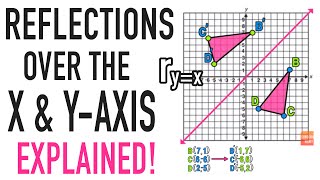
In geometry a reflection is a type of rigid transformation that flips a shape over a line called the mirror line. On the coordinate plane the mirror line can be the x‑axis, the y‑axis, or any other straight line. When a point is reflected, its distance from the mirror line stays the same, but its position on the opposite side is reversed.
Reflecting Across the X‑Axis
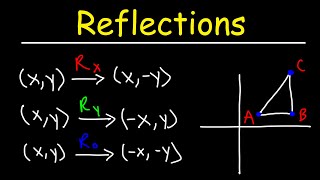
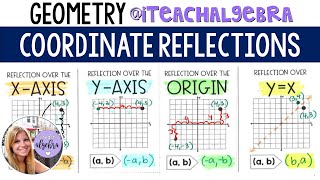
The rule for reflecting a point across the x‑axis is simple: the x‑coordinate stays unchanged while the y‑coordinate changes sign. In algebraic form, a point (x, y) becomes (x, –y). This means that every point moves vertically, creating a mirror image that is the same distance above or below the x‑axis.
Reflecting Across the Y‑Axis
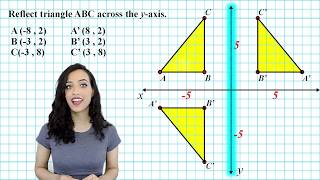
When reflecting across the y‑axis, the y-coordinate remains the same and the x-coordinate changes sign. Algebraically, (x, y) becomes (–x, y). The shape is mirrored horizontally, preserving its vertical size while reversing its left‑right placement.
How to Perform a Reflection Step‑by‑Step
- Identify the mirror line. Determine whether the shape is being reflected across the x‑axis, the y‑axis, or another line.
- Write down the coordinates of each vertex. List the (x, y) pairs for all corners of the original shape.
- Apply the appropriate rule. Use (x, –y) for the x‑axis or (–x, y) for the y‑axis to find the reflected coordinates.
- Plot the new points. On the same coordinate plane, mark each reflected vertex using its new coordinates.
- Connect the points. Draw straight lines between the reflected vertices in the same order as the original shape to complete the reflected figure.
Common GCSE Exam Questions
GCSE Maths papers often ask students to reflect a shape and then state the coordinates of a specific point, or to describe the effect of the reflection on the shape’s properties. Typical questions include:
- Reflect triangle ABC across the x‑axis and give the coordinates of vertex A′.
- Explain why the area of a shape does not change after a reflection.
- Find the equation of the mirror line if a shape is reflected from (2, 3) to (–2, 3).
Practice Tips
- Check your work. After reflecting, verify that each point is the same distance from the mirror line as its original.
- Use a grid. Drawing on squared paper helps keep distances accurate.
- Label clearly. Mark original and reflected points with different colours or letters to avoid confusion.
Where to Learn More
Free video lessons that explain coordinate plane reflections are available on Khan Academy. Their GCSE Maths section is suitable for students aged 14+ and covers both x‑axis and y‑axis reflections, as well as reflections across arbitrary lines. Starting the practice early helps build confidence for exam questions.
Summary
A coordinate plane reflection is a straightforward transformation that mirrors a shape across a line. By remembering the sign‑change rules — (x, y) → (x, –y) for the x‑axis and (x, y) → (–x, y) for the y‑axis — students can accurately reflect any object. Practising with worksheets, using graph paper, and watching clear instructional videos such as those on Khan Academy will strengthen understanding and improve performance on GCSE Maths assessments.