Division Vocabulary: Mastering the Language of Sharing
Division is more than a simple arithmetic operation; it is a way of organizing, sharing, and understanding relationships between numbers. When students hear the word “division,” they often think only of the symbol ÷ or the slash /. In reality, a successful division problem relies on a clear grasp of four essential terms: dividend, divisor, quotient, and remainder. This article explores each term, shows how they interact, and offers practical ideas for teaching 6th‑grade learners.
Key Terms in Every Division Problem
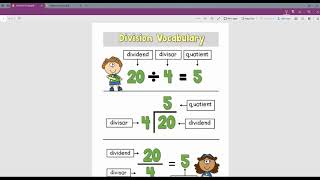
Dividend
The dividend is the number that is being divided. It represents the total amount of objects, money, or measurements that need to be split into equal parts. In everyday language, the dividend answers the question, “What do we have to share?”
Divisor
The divisor tells us how many equal groups we want to create or how many items each group should contain. It is the number that “does the dividing.” When the divisor is larger than the dividend, the quotient will be less than one, and a remainder may appear.
Quotient
The quotient is the result of the division. It indicates either the number of groups formed or the size of each group, depending on how the problem is framed. In a classroom setting, the quotient often answers the question, “How many items does each student receive?”
Remainder
The remainder is what is left over after the dividend has been divided as evenly as possible by the divisor. It represents the objects that cannot be placed into a full group. Understanding remainders is crucial for topics such as fractions, decimals, and modular arithmetic.
How the Terms Work Together – A Step‑by‑Step Example
Consider the classic problem: 12 ÷ 4 = ?
- Dividend: 12 – the total number of items.
- Divisor: 4 – the number of groups we want.
- Quotient: 3 – each group receives three items.
- Remainder: 0 – there are no items left over.
When the division is exact, the remainder is zero. If we change the problem to 13 ÷ 4, the quotient remains 3, but the remainder becomes 1 because one item cannot be placed into a full group of four.
Why Knowing the Vocabulary Matters
- Improved problem‑solving: Recognizing each part of a division problem helps students break down complex word problems into manageable steps.
- Clear communication: Using the correct terms enables precise discussion with peers, teachers, and parents.
- Foundation for advanced concepts: Mastery of dividend, divisor, quotient, and remainder prepares learners for fractions, ratios, and algebraic expressions.
- Confidence in math: When students can name each component, they feel more in control of the process and less intimidated by larger numbers.
Real‑World Situations That Use Division Vocabulary
- Cooking and recipe scaling: If a recipe calls for 6 cups of flour for 3 batches, the flour (dividend) is divided by the number of batches (divisor) to find the amount per batch (quotient). Any leftover flour becomes the remainder.
- Financial budgeting: A monthly allowance (dividend) divided among several expense categories (divisor) yields the amount allocated to each category (quotient), with any leftover funds recorded as a remainder.
- Classroom supplies: Distributing 28 pencils among 5 students requires the teacher to calculate the quotient (5 pencils each) and the remainder (3 pencils left over).
- Data analysis: When calculating average scores, the total points earned (dividend) are divided by the number of tests (divisor) to find the average (quotient). Any fractional part can be expressed as a remainder or converted to a decimal.
Teaching Strategies for 6th‑Grade Classrooms
Effective instruction blends visual, auditory, and kinesthetic approaches. Below are proven techniques that align with the curriculum and keep students engaged.
- Use visual models: Draw arrays, area models, or number lines to illustrate how the dividend is split by the divisor.
- Incorporate real‑world word problems: Connect division to everyday scenarios such as sharing snacks, planning trips, or dividing sports equipment.
- Leverage technology: The NEW Math Game at Mage Math offers interactive levels where students practice dividend, divisor, quotient, and remainder in a game‑based environment.
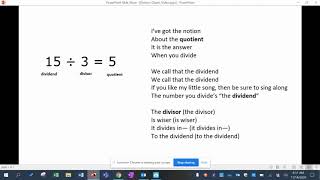
- Watch instructional videos: Mrs. Tanner’s introduction to division vocabulary and Mr. J’s “Parts of a Division Problem” video both break down each term with clear examples.
- Practice with manipulatives: Use counters, blocks, or digital tokens to physically group items, reinforcing the meaning of each term.
- Encourage peer teaching: Pair students so one explains a problem while the other checks the vocabulary usage.
Interactive Resources to Reinforce Learning
Supplementary materials can deepen understanding and provide extra practice outside the classroom.
- Mage Math – A full‑featured video game that turns division practice into an adventure, complete with levels focused on dividend, divisor, quotient, and remainder.
- Mr. J’s YouTube channel – Features the video “Welcome to Parts of a Division Problem: Dividend, Divisor, Quotient, & Remainder with Mr. J!” which walks students through each term step by step.
- Math Open Reference – Offers interactive calculators and visual explanations for division concepts.
- Mrs. Tanner’s classroom handouts – Provide concise definitions and practice grids that align with 6th‑grade standards.
Conclusion
Mastering division vocabulary is a cornerstone of mathematical fluency. By clearly distinguishing the dividend, divisor, quotient, and remainder, students gain a powerful toolkit for solving word problems, interpreting data, and tackling higher‑level math. Incorporating visual aids, real‑world examples, and engaging digital resources such as Mage Math ensures that learners not only understand the terms but can apply them confidently across subjects. Whether you are a teacher preparing lesson plans or a student seeking extra practice, a solid grasp of division vocabulary will pave the way for success in mathematics and beyond.