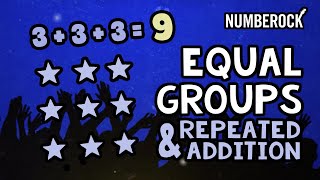
Equal Groups Multiplication: A Simple Path to Number Sense
Multiplication is more than a table of numbers; it is a way to think about grouping and scaling. When we talk about equal groups multiplication, we mean the idea that a product represents the same sized groups added together. For example, 4 × 3 can be visualized as four groups of three objects each, or three groups of four objects. This concept is foundational for students in 2nd and 3rd grade and beyond.
What Is Equal Groups Multiplication?
In equal groups multiplication, the factors are the sizes of the groups, and the product is the total number of objects. The key idea is that the order of the factors does not change the result—4 × 3 is the same as 3 × 4. This symmetry is a direct consequence of the commutative property of multiplication.
Why Understanding Equal Groups Matters
- Builds Conceptual Clarity: Students move from counting items to recognizing patterns in repeated groups.
- Supports Word‑Problem Solving: Many real‑world problems ask for “how many” items in equal sets.
- Prepares for Advanced Topics: Concepts like distributive property and area models stem from equal groups thinking.
How to Teach Equal Groups Multiplication
Teaching this idea can be engaging when it blends concrete manipulatives, visual models, and digital tools. Below are practical steps for teachers and parents.
1. Start with Repeated Addition
- Introduce the idea: Show that 5 + 5 + 5 equals 15, and then ask: “What if we had 3 groups of 5? What would that look like?”
- Connect to multiplication: Explain that 3 × 5 is the same as adding 5 three times.
- Use number lines: Have students step 5 units at a time, three times, to visualize the total.
2. Use Physical Manipulatives
- Base‑ten blocks, counting bears, or stickers can help students arrange equal groups.
- Encourage them to count rows and columns, noticing that the arrangement can change while the total stays the same.
3. Draw Area Models
Draw a rectangle divided into rows and columns. Label the number of rows and columns. The area of the rectangle (rows × columns) gives the product. This visual reinforces the equal groups idea.
4. Integrate Digital Resources
Platforms like Numberock offer interactive activities where students can drag objects to form equal groups and see the multiplication facts pop up. A free month of access is available for 2nd and 3rd grade teachers, making it easy to embed these lessons into lesson plans.
5. Story‑Based Learning
Characters such as Curious Chloe and Sunglow can guide students on a gardening adventure. For instance, “Let’s plant 4 rows