Understanding Fractions With Number Bonds
In elementary mathematics, the concept of fractions with number bonds provides a visual and logical way to see how parts make a whole. By linking fractions to the familiar idea of number bonds—pairs of numbers that add up to a target value—students can decompose and recombine fractions with confidence. This approach is a core component of Module 5 Lesson 8, where learners represent parts of one whole as fractions and explore how to break them down into simpler pieces.
Why Number Bonds Matter in Fraction Work
Number bonds are traditionally used with whole numbers to illustrate relationships such as 5 + 3 = 8. When the same principle is applied to fractions, it helps students see that a fraction can be split into two (or more) smaller fractions that together equal the original amount. This decomposition supports:
- Better mental arithmetic with fractions.
- Clearer understanding of equivalent fractions.
- Confidence when converting improper fractions to mixed numbers.
Decomposing Fractions: The Basic Technique
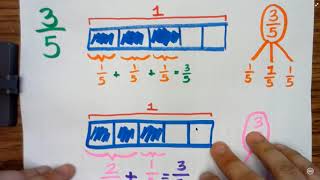
Decomposing, or “breaking apart,” a fraction involves writing it as the sum of two fractions that share the same denominator. For example, the fraction 3/5 can be expressed as 1/5 + 2/5. This process mirrors the number bond 1 + 2 = 3, but the numbers are fractions of a whole.
In practice, teachers often start with a simple fraction like 1/5 and demonstrate how it repeats across a unit. By showing that 1/5 placed five times creates a whole, learners can see how 3/5 is just three of those pieces, and how it can be split further into 1/5 and 2/5. This visual representation reinforces the idea that fractions are parts of a single, complete unit.
Using Number Bonds to Represent Parts of One Whole
When a teacher asks, “What fractions add up to 4/6?” students can think in terms of number bonds:
- Identify a convenient split, such as 2/6 + 2/6.
- Or decompose further: 1/6 + 1/6 + 2/6.
Each of these bonds demonstrates that the whole fraction can be built from smaller, equally sized pieces. The activity aligns with the Module 5 Lesson 8 goal of representing parts of a whole as fractions with number bonds.
Converting Improper Fractions with Number Bonds
An improper fraction has a numerator larger than its denominator, such as 9/4. To convert it, students can use number bonds to separate whole units from the fractional remainder:
- Determine how many whole units fit into the numerator: 9 ÷ 4 = 2 whole units.
- Find the leftover fraction: 9 − (2 × 4) = 1, giving the remainder 1/4.
- Combine the results: 9/4 = 2 + 1/4 (or 2 1/4