Key Math Words For Word Problems: A Teacher’s Guide
Word problems are a cornerstone of elementary mathematics, yet many students stumble over the language that hides the numbers. By mastering a core set of key math words, learners can translate everyday scenarios into accurate equations. This article breaks down the most common terms, shows how they signal specific operations, and offers classroom‑ready strategies for reinforcing understanding.
Why Vocabulary Matters in Math Word Problems
Unlike pure computation, word problems require students to read and interpret. The same numerical relationship can be described in dozens of ways, and a single unfamiliar word can derail a child's solution path. When teachers explicitly teach the language of math, they give students a reliable toolkit that works across subjects—from basic addition to algebraic reasoning.
Core Operation Words
The following list groups words by the operation they usually indicate. Encourage students to underline or highlight these terms when they first encounter a problem.
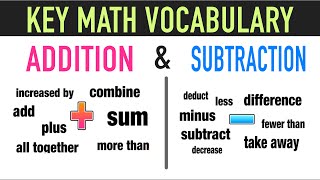
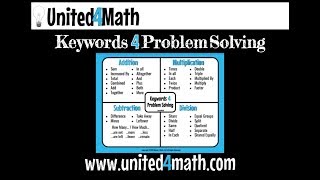
- Addition: total, sum, combined, together, increased by, added to, plus, more than
- Subtraction: difference, left, remain, fewer, less, minus, decrease, after removing
- Multiplication: product, times, of, each, per, groups of, total of, repeated addition
- Division: quotient, per, out of, shared equally, split, ratio, each, average
Transition Words that Signal Multi‑Step Thinking
Many problems require more than one operation. Transition words help students recognize when to shift gears.
- Then – Indicates a second step after the first calculation.
- After – Signals a sequential operation, often subtraction or addition.
- Because – Connects cause and effect, useful for setting up equations.
- How many – Directs attention to the unknown quantity.
- What is the total – Prompts a summation of all parts.
Contextual Clues for Fractions and Decimals
When problems involve parts of a whole, specific words appear.
- Half, quarter,

![[August SAT Math] Weird Trick To Solve All Word Problems - Raise Your SAT SCORE!](https://i.ytimg.com/vi/vhMRoD7uA4w/mqdefault.jpg)