Understanding the Conversion: LPM to m³ /hr
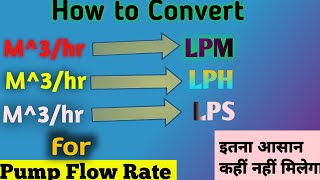
When working with fluid dynamics, especially in water‑treatment or desalination projects, you will often encounter the need to convert flow rates expressed in liters per minute (LPM) to cubic meters per hour (m³ /hr). Both units measure volumetric flow, but they belong to different measurement systems and time scales. Knowing how to convert them quickly helps engineers, technicians, and students keep their calculations consistent and avoid costly errors.
Why the Conversion Matters
In plant engineering, the design specifications for pumps, membranes, and pipelines are usually given in m³ /hr. However, operational data from flow meters, handheld devices, or laboratory tests are often recorded in LPM. Converting between these units allows you to:
- Compare real‑time measurements with design criteria.
- Size equipment correctly for both startup and steady‑state conditions.
- Communicate clearly with international teams that may use different unit conventions.
Simple Formula for LPM → m³ /hr
The conversion is straightforward because both units are linear multiples of the base volume unit (liter) and time unit (minute or hour). The relationship is:
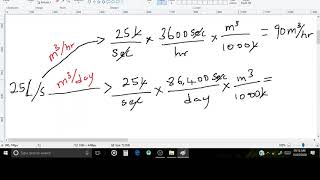
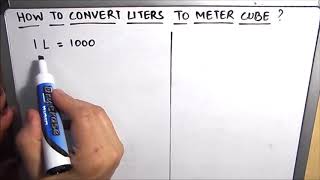
- 1 m³ = 1,000 L.
- 1 hour = 60 minutes.
Combining these two facts gives the conversion factor:
1 LPM = 0.06 m³ /hr
Mathematically:
Flow (m³ /hr) = Flow (LPM) × 1,000 L / m³ ÷ 60 min / hr = Flow (LPM) × 0.06
Step‑by‑Step Conversion Guide
Below is a practical workflow you can follow when converting any LPM value to m³ /hr.
- Record the LPM value. Ensure the flow meter is calibrated and the reading is stable.
- Multiply by 0.06. Use a calculator or spreadsheet to apply the factor directly.
- Verify the result. If possible, compare the converted value with a secondary measurement (e.g., a flow logger that reports in m³ /hr).
- Document the conversion. Include both the original LPM reading and the calculated m³ /hr value in your reports.
Examples of Common Conversions
Here are a few typical scenarios you might encounter on a plant floor or in a classroom.
- 10 LPM → m³ /hr: 10 × 0.06 = 0.6 m³ /hr.
- 250 LPM → m³ /hr: 250 × 0.06 = 15 m³ /hr.