Curated coverage and comprehensive guides by Highlights.
## Understanding M3/H to GPM Conversion
In the context of water flow and fluid dynamics, understanding unit conversions is crucial for accurate calculations and measurements. One common conversion involves changing cubic meters per hour (m3/h) to gallons per minute (gpm). This article aims to explain the concept of unit conversion, specifically focusing on converting m3/h to gpm, and provide a clear, step-by-step guide on how to perform this conversion.
### What are Cubic Meters per Hour (m3/h) and Gallons per Minute (gpm)?
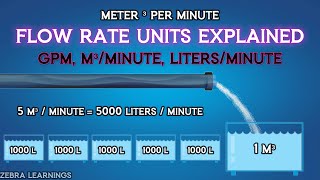
- **Cubic Meters per Hour (m3/h)**: This unit measures the flow rate of a fluid, indicating the volume of fluid that passes through a given surface in one hour. A cubic meter (m3) is a unit of volume in the metric system, equivalent to 1,000 liters. Therefore, m3/h represents the number of cubic meters of fluid flowing per hour.
- **Gallons per Minute (gpm)**: This is another unit of flow rate, commonly used in the United States. It measures the volume of fluid that flows through a particular point in one minute. A gallon is a unit of volume, and in the context of flow rates, gpm signifies the number of gallons of fluid flowing per minute.
### Importance of Unit Conversion in Fluid Dynamics
Unit conversions are essential in fluid dynamics and engineering because they allow professionals to work with different measurement systems seamlessly. In the case of water flow, being able to convert between m3/h and gpm is particularly useful, as these units are used in various applications and regions. For instance, while the metric system (including m3/h) is widely used around the world, the United States often uses customary units like gallons per minute (gpm) for flow rate measurements.
### Converting M3/H to GPM
To convert m3/h to gpm, we need to know the conversion factors between the units involved:
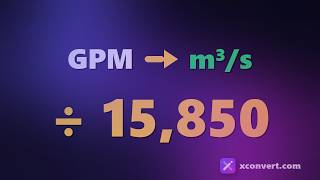
1. **1 cubic meter (m3) = 264.172 gallons (gal)**: This is the conversion factor for volume.
2. **1 hour (h) = 60 minutes (min)**: This is the conversion factor for time.
The conversion from m3/h to gpm can be calculated as follows:
- First, convert cubic meters to gallons: 1 m3 = 264.172 gallons.
- Then, convert hours to minutes: 1 hour = 60 minutes.
So, to convert m3/h to gpm:
\[ \text{m3/h} \times 264.172 \, \text{gal/m3} \div 60 \, \text{min/h} = \text{gpm} \]
\[ \text{m3/h} \times 4.40287 \, \text{gal/min/m3} = \text{gpm} \]
Or simply:
\[ \text{m3/h} \times 4.403 = \text{gpm} \] (Approximately)
### Example Conversion
Let's convert 10 m3/h to gpm:
\[ 10 \, \text{m3/h} \times 4.403 = 44.03 \, \text{gpm} \]
Therefore, 10 m3/h is approximately equal to 44.03 gpm.
### Applications of M3/H to GPM Conversion
Understanding and being able to perform the conversion from m3/h to gpm is crucial in various fields, including:
- **Water Treatment and Supply**: For designing and operating water treatment plants, accurate flow rate measurements are necessary.
- **HVAC Systems**: Heating, ventilation, and air conditioning systems often involve water flow for heating or cooling purposes.
- **Irrigation Systems**: Accurate flow rates are essential for efficient irrigation.
- **Industrial Processes**: Many industrial processes involve the flow of liquids, requiring precise measurements.
### Conclusion
Converting between different units of flow rate, such as m3/h to gpm, is a fundamental skill in fluid dynamics and engineering. By understanding the conversion factors and applying them correctly, professionals can ensure accurate measurements and efficient system designs. Whether in water treatment, HVAC, irrigation, or industrial applications, the ability to convert m3/h to gpm is an invaluable tool.
Related Coverage
The GPM to m3/h Mistake That Oversizes Pumps
You're sizing a pump. Your datasheet says a hundred