Understanding Main Idea and Details
Main idea and details are the building blocks of every coherent text. The main idea is the central point the author wants the reader to grasp, while details are the supporting facts, examples, and explanations that flesh out that point.
What Is the Main Idea?
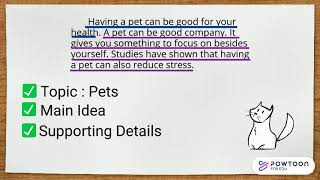
The main idea is the thesis or primary message of a passage. It answers the question, “What is the author trying to say?” It is usually one sentence that can be summarized in a few words. For instance, in a paragraph about the benefits of exercise, the main idea might be, “Regular physical activity improves overall health.”
What Are Details?
Details are the pieces of evidence that back up the main idea. They can be statistics, anecdotes, definitions, or descriptions. In the same paragraph, details would include specific health benefits, studies that support the claim, and tips for starting an exercise routine.
Why Identifying Main Idea and Details Matters
Understanding the main idea helps readers:
- Summarize texts quickly.
- Retain information.
- Answer comprehension questions.
- Write effective summaries and essays.
For teachers and parents, teaching children to distinguish between the main idea and details promotes:
- Critical thinking.
- Reading fluency.
- Academic success across subjects.
How to Determine the Main Idea
Use these steps to find the central point in any text:
- Read the entire passage. Skimming can lead to missing subtle cues.
- Look for recurring themes. Words or phrases that appear frequently often signal the main idea.
- Identify the topic sentence. In many paragraphs, the first or last sentence contains the main idea.
- Ask “What is the author’s purpose?” Whether to inform, persuade, or entertain, the purpose guides the main idea.
- Summarize in one sentence. If you can express the paragraph’s core message in a concise sentence, you’ve likely found the main idea.
Topic Versus Main Idea
The topic is the general subject—e.g., “exercise.” The main idea is the specific point about that topic—e.g