Understanding Multiplying And Dividing Powers Of Ten
Working with powers of ten is a fundamental skill in mathematics, especially when dealing with large numbers, scientific notation, and real‑world measurements. This article explains how to multiply and divide powers of ten quickly and accurately, provides step‑by‑step examples, and highlights common pitfalls to avoid.
Why Powers Of Ten Matter
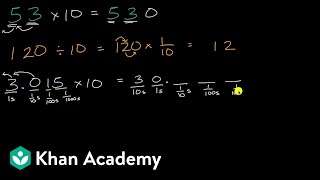
Every decimal number can be expressed as a product of a coefficient and a power of ten. For example, 5,300 equals 5.3 × 10³. Mastering the rules for multiplying and dividing these powers helps students simplify calculations, convert units, and understand scientific data.
The Basic Rules
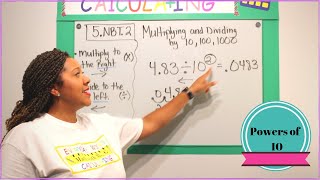
When you work with powers of ten, the exponent tells you how many zeros follow the 1. The two essential rules are:
- Multiplication: Add the exponents.
10ⁿ × 10ᵐ = 10ⁿ⁺ᵐ - Division: Subtract the exponents.
10ⁿ ÷ 10ᵐ = 10ⁿ⁻ᵐ
These rules apply whether the numbers are whole, fractional, or expressed in scientific notation.
Multiplying Powers Of Ten: Step‑By‑Step
Consider the product 3 × 10⁴ × 4 × 10². Follow these steps:
- Separate the coefficients (the numbers not involving ten): 3 × 4 = 12.
- Combine the powers of ten by adding the exponents: 10⁴ × 10² = 10⁶.
- Put the results together: 12 × 10⁶, which can be written as 1.2 × 10⁷ if you prefer scientific notation.
This method works for any number of factors. For example, 5 × 10³ × 2 × 10⁵ × 0.1 × 10⁻² becomes:
- Coefficients: 5 × 2 × 0.1 = 1
- Exponents: 3 + 5 + (‑2) = 6
- Result: 1 × 10⁶ = 10⁶
Dividing Powers Of Ten: Step‑By‑Step
Division follows the same principle, but you subtract exponents. Take the example 8 × 10⁷ ÷ 4 × 10