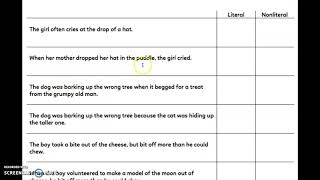
What Is Nonliteral Language?
Nonliteral language—often called figurative language—refers to words or expressions that convey a meaning different from their literal definition. When a speaker says “the world is a stage,” the audience understands a deeper idea about life’s performative nature, not that the planet is literally a theater. This shift from literal to figurative meaning helps writers and speakers add color, emotion, and nuance to communication.
Common Types of Nonliteral Language
Metaphor
A metaphor directly equates two unlike things without using “like” or “as.” Examples include:
- He is a rock. – suggesting stability and reliability.
- Time is a thief. – implying that time steals moments.
Simile
A simile draws a comparison using “like” or “as.” Typical classroom examples are:
- She sang like an angel.
- His jokes are as sharp as a razor.
Idiom
Idioms are fixed phrases whose meanings cannot be deduced from the individual words. Some everyday idioms are:
- Kick the bucket – meaning to die.
- Break the ice – meaning to start a conversation.
Hyperbole
Hyperbole is purposeful exaggeration used for emphasis:
- I’ve told you a million times.
- That backpack weighs a ton.
Personification
Personification gives human traits to non‑human objects or ideas:
- The wind whispered through the trees.
- The city never sleeps.
Why Nonliteral Language Matters in the Classroom
According to the Common Core standard RL.3.4, students must determine the meaning of words and phrases as they are used in a text, distinguishing literal from figurative language. Mastery of nonliteral language supports reading comprehension, writing fluency, and critical thinking. When learners recognize that “the rain poured down like a waterfall” is a simile, they can visualize the scene more vividly and infer the author’s mood.
Real‑World Examples and Multimedia Resources
Teachers can reinforce these concepts with short videos. A Screencast‑O‑Matic recording (screencast‑o‑matic.com) demonstrates how to differentiate “literally” from “figuratively” in American English. Another Powtoon tutorial (powtoon.com/youtube) offers animated explanations of each figurative device, making abstract ideas concrete for visual learners.
In a YouTube mini‑lesson titled “Weather and Climate” (mini lesson #10), Ms. Johnson uses nonliteral language—e.g., “the sun smiled down on us”—to illustrate how figurative speech appears in everyday conversation and scientific description alike.
Nonliteral Language in Movies and Pop Culture
Film scripts frequently rely on figurative language to create memorable lines. Consider the classic line from *The Lion King*: “Life’s a circle.” The metaphor conveys the idea of continuity and interconnectedness without stating it outright. Analyzing such lines helps students see how writers use nonliteral language to shape tone, develop characters, and reinforce themes.
Practical Classroom Activities
- Identify the Device: Provide students with short passages and ask them to label each instance of metaphor, simile, idiom, hyperbole, or personification.
- Create a Comic Strip: Using Powtoon or a simple drawing app, students illustrate a literal sentence and then rewrite it with a figurative twist.
- Video Reflection: After watching a Screencast‑O‑Matic lesson on “literally vs. figuratively,” learners write a brief paragraph explaining the difference in their own words.
- Movie Quote Hunt: Assign groups to find five lines from favorite movies that contain nonliteral language, then present the meaning behind each quote.
Tips for Using Nonliteral Language Effectively
- Know your audience. Overly complex metaphors can confuse younger readers.
- Keep it relevant. Choose figurative expressions that support the main idea rather than distract from it.
- Balance literal and figurative. A text that is 100% figurative may become hard to follow; mixing both styles aids comprehension.
Conclusion
Nonliteral language enriches communication by allowing writers and speakers to convey abstract concepts, emotions, and vivid imagery in a compact, memorable form. From classroom standards like RL.3.4 to animated tutorials on Powtoon and Screencast‑O‑Matic, there are abundant resources to help students recognize and employ metaphors, similes, idioms, hyperbole, and personification. By practicing these devices through reading, discussion, and multimedia projects, learners develop stronger analytical skills and become more expressive writers—ready to navigate both literary texts and everyday conversation with confidence.