Understanding Positive and Negative Integers on a Number Line
When students first encounter integers, the idea of a number line can feel abstract. A number line is a straight line that extends infinitely in both directions, with a zero point in the middle. Numbers to the right of zero are positive, while numbers to the left are negative. Visualizing these integers on a line helps learners grasp concepts such as magnitude, direction, and the relationship between opposites.
Plotting Integers: Step‑by‑Step
To plot integers accurately, follow these simple steps:
- Mark the origin: Place a dot at the center and label it 0.
- Divide the line into equal segments: Each segment represents one unit. Use a ruler for precision.
- Label the positive side: Move right from zero and label each segment 1, 2, 3, and so on.
- Label the negative side: Move left from zero and label each segment –1, –2, –3, etc.
- Plot points: Place a dot on the segment corresponding to the integer you want to represent.
In a video lesson, the instructor demonstrates how to locate and plot integers, showing clear visuals that help keep the process intuitive.
Adding Positive and Negative Integers
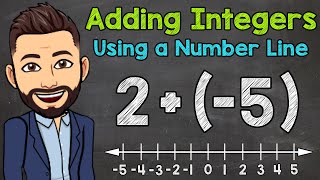
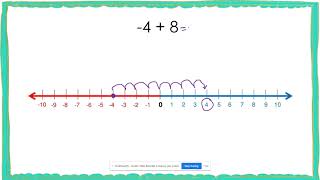
Adding integers on a number line is a visual way to understand the operation. To add a positive and a negative number:
- Start at the first number: For example, begin at –3.
- Move right: The amount of movement equals the absolute value of the second number. If you add +5, move five units to the right.
- Arrive at the result: The final position on the line is the sum, which in this case is +2.
This method aligns with the concept that adding a positive number is equivalent to moving forward, while adding