Mastering Integers with a Printable Number Line With Positive And Negative Numbers
Understanding the concept of integers—which include positive numbers, negative numbers, and zero—is a fundamental milestone in mathematics. For many students, the jump from basic counting to working with negative values can be challenging. One of the most effective tools for visualizing these concepts is a printable number line with positive and negative numbers.
A number line serves as a visual map, allowing learners to see the relationship between numbers and understand how values change as they move left or right. Whether you are a teacher looking for classroom resources or a parent helping with homework, using a physical number line can turn abstract calculations into concrete movements.
What is a Number Line with Positive and Negative Numbers?
A standard number line is a horizontal line where a point, called the origin, is marked as zero. Numbers to the right of zero are positive integers, and numbers to the left of zero are negative integers.
- The Origin: Zero acts as the center point. It is neither positive nor negative.
- Positive Direction: Moving to the right increases the value (1, 2, 3...).
- Negative Direction: Moving to the left decreases the value (-1, -2, -3...).
- Symmetry: Every positive number has a corresponding negative opposite (e.g., 5 and -5) located at the same distance from zero.
How to Use a Printable Number Line for Basic Operations
Using a printable number line is particularly helpful when introducing the rules of adding and subtracting integers. Instead of memorizing complex rules, students can simply "hop" along the line to find the answer.
Adding Integers
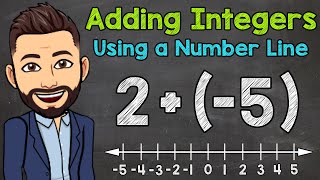
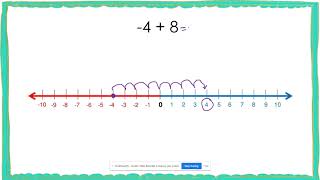
When adding integers, the number line provides a clear path to the sum. For example, to solve -2 + 5:
- Locate the starting point at -2.
- Since you are adding a positive number, move 5 units to the right.
- The landing point is 3, which is the final answer.
Subtracting Integers
Subtraction is often the most confusing part of early algebra. A number line helps by visualizing subtraction as moving in the opposite direction. To solve 3 - 7:
- Start at 3.
- Move 7 units to the left.
- The landing point is -4.
Comparing and Ordering Integers
A printable number line is an essential tool for learning how to compare values. A common mistake for beginners is thinking that -10 is "bigger" than -2 because 10 is larger than 2. However, the number line proves otherwise.
By observing the line, students can see that any number to the right is always greater than any number to the left. Therefore, -2 is greater than -10 because it is closer to the positive side of the line. This visual aid makes it easy to plot points and determine which integer is the minimum or maximum in a set.
Tips for Using Number Line Resources
To get the most out of your printable number line, consider these strategies:
- Laminate the Page: Laminating your printable allows students to use dry-erase markers to plot points and draw "hops" without ruining the paper.
- Use Physical Tokens: Place a coin or a small button on the number line to represent the current position during a calculation.
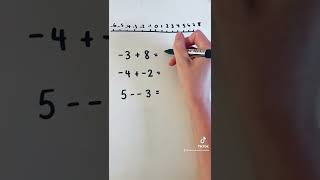
- Integrate Video Tutorials: Supplement physical tools with digital learning. Many students benefit from watching a basic intro video showing how to locate and plot numbers or exploring how to compare integers through interactive examples.
- Practice Finding Missing Numbers: Use the line to solve equations like -3 + ? =