Pythagorean Theorem on a Coordinate Plane
When you work on a coordinate plane, distances between points are not always obvious. The Pythagorean Theorem gives a reliable way to calculate the length of a line segment, turning any pair of points into a simple right triangle. This article explains how to use the theorem on a coordinate plane, walks through step‑by‑step calculations, and highlights common mistakes to avoid.
Key Concepts
- The coordinate plane consists of an x‑axis (horizontal) and a y‑axis (vertical). Each point is written as (x, y).
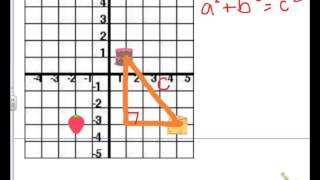
- A line segment connecting two points can be represented as a right triangle whose legs lie along the axes.
- The distance formula, derived from the Pythagorean Theorem, provides a direct method for finding that segment’s length.
Distance Formula
If two points are (x₁, y₁) and (x₂, y₂), the distance d between them is:
d = √[(x₂ - x₁)² + (y₂ - y₁)²]
This formula is essentially a restatement of the Pythagorean Theorem where the horizontal difference is one leg and the vertical difference is the other.
Example Problems
- Points A(2, 3) and B(5, 7)
Δx = 5 - 2 = 3, Δy = 7 - 3 = 4.
d = √(3² + 4²) = √(9 + 16) = √25 = 5. - Points C(0, 0) and D(-4, 12)
Δx = -4 - 0 = -4, Δy = 12 - 0 = 12.
d = √((-4)² + 12²) = √(16 + 144) = √160 ≈ 12.65.
Using the Pythagorean Theorem
When you plot the two points on a graph, draw vertical and horizontal lines to create a right triangle. The legs are the absolute differences in the x and y coordinates