Rational Numbers on a Number Line: A Clear Introduction
Understanding how rational numbers appear on a number line is a fundamental skill in middle‑school mathematics. This article offers a step‑by‑step guide to identifying, ordering, and graphing rational numbers, with practical tips that align with the latest NEET preparation resources.
Welcome to An Intro to Rational Numbers
A rational number is any number that can be expressed as the quotient p/q, where p and q are integers and q ≠ 0. Examples include ½, –3, 0.75, and –12/5. Because they can be written as fractions, rational numbers fill the gaps between whole numbers on a number line, creating a dense set of points.
Welcome to Identifying Rational Numbers on the Number Line
Identifying a rational number on a number line involves two simple steps:
- Convert the fraction to a decimal or a mixed number if needed.
- Locate the corresponding point between the nearest integers.
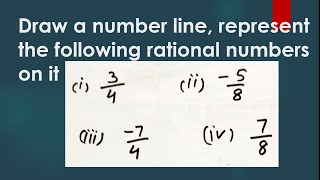
For instance, the fraction 3/4 equals 0.75. Starting at 0, move three‑quarters of the distance to 1 and place a dot. The same method works for negative rational numbers; –5/2 equals –2.5, so you would count two and a half units left of zero.
Welcome to How to Order Rational Numbers
Ordering rational numbers on a number line follows the same logic as ordering any real numbers: numbers further to the right are larger. To compare two fractions without converting them to decimals, use cross‑multiplication:
- Given a/b and c/d, compare a·d with c·b.
- If a·d > c·b, then a/b > c/d.
This technique is especially helpful during timed NEET practice sessions, where speed and accuracy are crucial.
Welcome to Graphing Rational Numbers
Graphing rational numbers on a number line is straightforward once you master the spacing of equal intervals.
Step‑by‑Step Graphing Process
- Draw a horizontal line and mark a point for zero.
- Choose a unit length that comfortably fits the fractions you will plot (e.g., 1 cm per unit).
- Label integer points (…, –2, –1, 0, 1, 2, …).
- Divide each unit into equal parts that match the denominator