Understanding Repeated Subtraction for Division
Division is often introduced as a single-step operation, but the underlying concept can be traced back to the simple act of repeated subtraction. By breaking a dividend into equal groups through successive subtraction, students can grasp both the quotient and the remainder in a concrete way. This method is especially helpful for learners who are just beginning to work with whole numbers.
How Is Repeated Subtraction Used in Division?
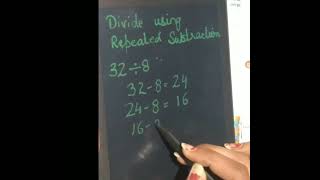
When you find whole-number quotients and remainders by repeatedly subtracting the divisor from the dividend, each subtraction represents one unit of the quotient. The process stops when the remaining number is smaller than the divisor, and that leftover value becomes the remainder. For example, to divide 23 by 5:
- 23 − 5 = 18 (first subtraction, quotient = 1)
- 18 − 5 = 13 (second subtraction, quotient = 2)
- 13 − 5 = 8 (third subtraction, quotient = 3)
- 8 − 5 = 3 (fourth subtraction, quotient = 4)
Since 3 is less than 5, the process stops. The final answer is 4 R 3 (four with a remainder of three).
Why Teach Repeated Subtraction?
Using repeated subtraction aligns with the mission of many educational platforms: Make math fun, engaging, and oh‑so‑easy for both you & your students. It offers several pedagogical benefits:
- Concrete visualisation – Students see each subtraction as removing a group, reinforcing the idea of equal sharing.
- Foundation for algorithms – This method builds intuition for long division and for understanding remainders.
- Supports diverse learners – Visual and kinesthetic learners benefit from the step‑by‑step nature of the process.
Step‑by‑Step Guide for Teachers
Here’s a simple lesson plan you can adapt for classroom or home instruction:
- Introduce the concept – Explain that division asks, “How many times does the divisor fit into the dividend?”
- Model with objects – Use counters, blocks, or drawings to show subtraction of groups.
- Write the problem – Present a division statement, e.g., 48 ÷ 6.
- Subtract repeatedly – Guide students to subtract 6 from 48 until the remainder is smaller than 6.
- Count the subtractions – The number of subtractions equals the quotient; the final leftover is the remainder.
- Check the work – Multiply the quotient by the divisor and add the remainder to verify the original dividend.
For additional practice, direct learners to https://yourteacherbestie.com for fun activities and worksheets that reinforce this strategy.
Digital Resources and Community Support
Many online platforms provide ready‑made lesson materials that incorporate repeated subtraction. For example,