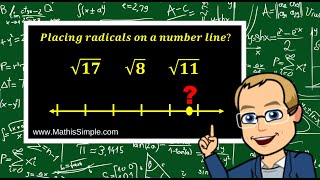
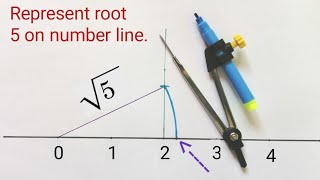
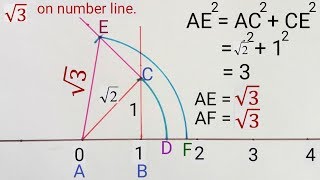
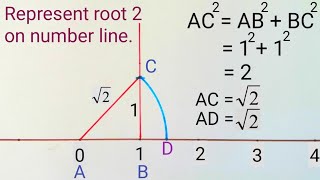
Understanding the Square Root on a Number Line
When students first encounter radicals, the idea of a square root can feel abstract. Placing the square root on a number line turns an invisible concept into a visual one, helping learners see where the value belongs relative to integers, fractions, and decimals. This article explains how to locate the square root of a number, why the method works, and how to estimate irrational results using simple techniques.
Why a Number Line Helps
Number lines are a common tool in middle‑school math because they provide a single, continuous scale that can represent integers, decimal numbers, fractions, and even irrational values. By plotting a square root on the same line, students can directly compare it to other familiar numbers, making the following concepts clearer:
- How the square root relates to the original number (e.g., √9 = 3).
- Why √2 is not a whole number and where it falls between 1 and 2.
- How to estimate the value of an irrational root without a calculator.
Step‑by‑Step: Finding √x on a Number Line
1. Identify Perfect Squares Around x
Start by locating the two perfect squares that surround the number x. For example, to find √7, note that 4 (2²) is less than 7 and 9 (3²) is greater than 7. This tells us that √7 lies between 2 and 3.
2. Mark the Bounding Integers
Draw a short segment on the number line from the lower integer (2) to the higher integer (3). These points become the anchors for the estimation.
3. Use Linear Approximation
Because the square‑root function is increasing but not linear, a simple linear interpolation gives a quick estimate. The formula is:
- Calculate the distance between the two perfect squares: Δ = (higher square) – (lower square).
- Find how far x is from the lower square: d = x – (lower square).
- Estimate the fractional part: fraction ≈ d / Δ.
- Add this fraction to the lower integer: √x ≈ lower integer + fraction.
Applying this to √7:
- Δ = 9 – 4 = 5
- d = 7 – 4 = 3
- fraction ≈ 3 / 5 = 0.6
- Estimate: √7 ≈ 2 + 0.6 = 2.6
The actual value of √7 is about 2.6458, so the linear approximation lands very close to the true result.
4. Refine with a Short Division Method (Optional)
If greater accuracy is needed, the Babylonian method (also called the “divide‑and‑average” technique)