Venn Diagram for Mitosis and Meiosis: A Clear Comparison Tool
Understanding the differences and similarities between mitosis and meiosis is essential for middle school biology. A Venn diagram helps students visualize the key points that separate these two types of cell division while highlighting the common processes they share. This article walks you through the fundamentals of each process, shows how to construct a useful Venn diagram, and offers study tips for sixth graders and beyond.
What Is Mitosis?
Mitosis is the cellular mechanism that produces two identical daughter cells from a single parent cell. It is the primary method of growth, repair, and asexual reproduction in multicellular organisms.
- Purpose: Replace damaged cells and increase body mass.
- Outcome: Two diploid cells that are genetically identical to the parent.
- Phases: Prophase, Metaphase, Anaphase, Telophase, and Cytokinesis.
- Resulting DNA: No change in chromosome number; each cell retains the same number of chromosomes as the original.
What Is Meiosis?
Meiosis is a specialized form of cell division that produces gametes—sperm and eggs—in sexual organisms. It reduces the chromosome number by half, creating genetic diversity.
- Purpose: Generate haploid gametes for sexual reproduction.
- Outcome: Four genetically unique cells, each containing half the chromosome number of the parent.
- Phases: Two successive divisions (Meiosis I and Meiosis II) each with Prophase, Metaphase, Anaphase, Telophase.
- Resulting DNA: Chromosome number halved; recombination and independent assortment increase genetic variation.
Using a Venn Diagram to Compare Mitosis and Meiosis
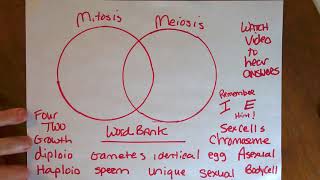
A Venn diagram is an effective visual aid that places the two processes in overlapping circles. Each circle contains unique attributes, while the intersection highlights shared steps.
Step 1: List Unique Features
- For the mitosis circle, write points such as “single division,” “produces 2 diploid cells,” and “no crossing over.”
- For the meiosis circle, include “two divisions,” “produces 4 haploid cells,” and “crossing over occurs.”
Step 2: Identify Shared Characteristics
- Both processes involve the phases of prophase, metaphase, anaphase, telophase, and cytokinesis.
- Both require DNA replication before the first division.
- Both result in cell division that ultimately increases the number of cells.